

Recently, some users have started receiving invitations to test the mem.ai 2.0 Alpha. I was lucky enough to get one of these notifications and decided to dust off my long-unused account to give it a try.
To cut to the chase: mem.ai 2.0 is now a genuinely AI-enhanced notes app, comparable to Google NotebookLM. However, it’s not yet the finished product, and there’s still plenty of room for improvement.
On a side note: just as I predicted back in 2021 that the wave of “Notion-like” note-taking apps would eventually lead to fierce competition, we’re now seeing the same thing happen with AI-powered knowledge management tools. The signs are already there—besides mem.ai, I’m aware of several other tools, both obvious and under-the-radar, entering this space. If mem.ai doesn’t carve out a unique niche soon, it risks being surrounded by tough competitors in the next round of this battle.
Mem: The Early Riser

Back in 2021, when the productivity world was buzzing over “Notion-like” apps, mem stood out as a smart note-taking tool that wowed a subset of productivity enthusiasts. While competitors were focusing on modular layouts and aesthetic designs, mem prioritized contextual relevance. For example, if you referenced “that meeting we had last time” or “the next project we’re working on,” most tools would require you to manually create links or tags. Mem, on the other hand, could understand what you were referring to and provide helpful prompts. This was thanks to its context-awareness and quick information capture mechanisms.
At its core, mem made it easy to gather information. You could use hotkeys for quick input, and later, it integrated with tools like cloud storage, Slack, and email. It even allowed you to capture content from Twitter (ever seen “mem it” replies under tweets?). This made mem a central hub for consolidating and analyzing all your workflow information.
At the time, mem was nothing short of revolutionary. Many users were eager to entrust all their notes and tasks to it, and early access to the platform was highly sought after. Keep in mind, this was before the AI boom and before anyone had even heard of ChatGPT. A tool that claimed to integrate all your workflow data, provide seamless collaboration, and offer intelligent contextual suggestions was, quite frankly, mind-blowing. Unsurprisingly, mem secured several million dollars in early funding with ease.
mem.ai 2.0: A Closer Look
Compared to the initial wow factor of mem 1.0 (and the subsequent mem X, which will eventually be folded into 2.0), mem 2.0 feels more… average. Here are my main impressions after testing it:
1. Standard Note-Taking Features
Mem 2.0 comes with all the usual features you’d expect in a modern note-taking app:
- A sleek editor that supports
/commands for adding modules. - Markdown shortcuts for formatting.
2. A “Collection” Organization System
Essentially, this is just a tagging system. However, it only supports single-level tags, unlike tools like Bear, which allow for nested tags.

3. Built-In AI Chat
There’s an AI chatbox where you can ask questions and get responses. Personally, I’m not a fan of this kind of integration. In my opinion, AI chat should be a standalone tool. Following my principle of creating a flexible “toolchain,” I prefer to pick the best AI solution available rather than being locked into one bundled with another app.
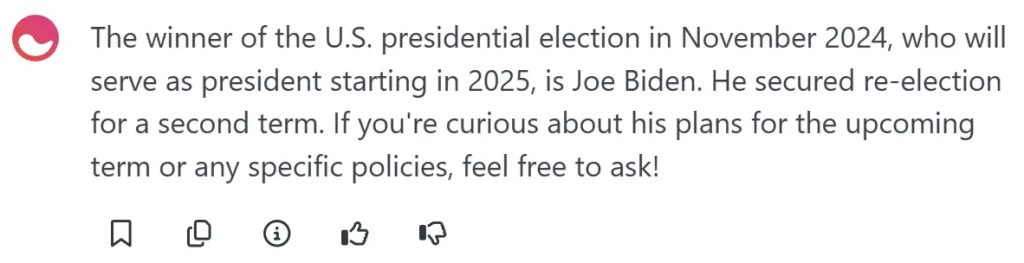
Also, the AI chat currently can’t perform web searches. For instance, it confidently told me that Biden won the 2024 U.S. presidential election—and no matter how many times I asked, it stuck to that claim. Clearly, it’s working with outdated or limited training data.
4. Smart Contextual Note Linking
This is mem’s original flagship feature: showing related notes based on context. While still useful, it’s no longer a standout capability today. Many other apps have similar features, like “related notes” or “linked references.” Even Evernote had something like this years ago, though it didn’t gain much traction (possibly because of the tech limitations at the time).
In fact, tools like Napkin are now leading the charge in the AI era with auto-linking features. Going forward, this kind of functionality is becoming more of a baseline expectation rather than a differentiator—much like Markdown support or / commands in editors.
Compatibility Issues with Mem 1.0
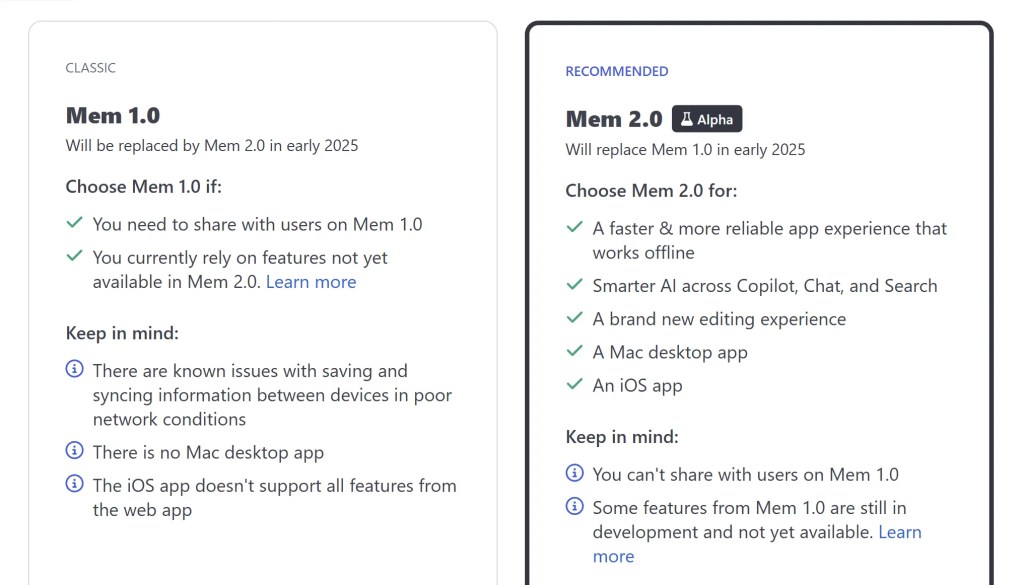
Yes, you read that right. Since mem 2.0 is a complete rebuild, there are some issues with mem 1.0. Your data won’t automatically carry over—you’ll need to manually import your notes and contacts. Some integration features from 1.0 also haven’t been implemented in 2.0 yet.
In short, mem 2.0 is basically a fresh start. This also explains why mem went quiet for several months—they were focused on building this from the ground up.
Final Thoughts
It’s too early to draw any definitive conclusions about mem.ai 2.0, especially since it’s still in the Alpha phase. However, the fact that this version is a complete overhaul of mem 1.0 and mem X suggests that mem has been struggling to keep up over the past two years amidst the tidal wave of AI tools.
That said, it’s not too late for mem to regain its footing. The key will be carving out a unique identity, rather than trying to go head-to-head with giants like Google NotebookLM.
And finally, brace yourselves for 2024—a year that’s likely to bring a flood of AI-powered knowledge management tools, much like the explosion of “Notion-like” apps we saw a few years ago.



 My Own Sys
Leave a comment